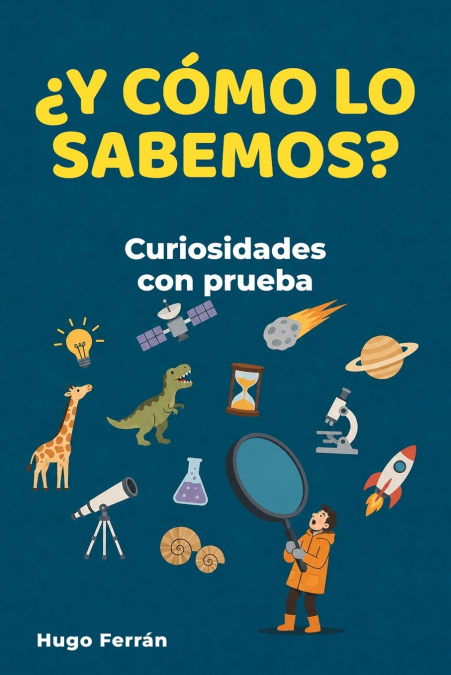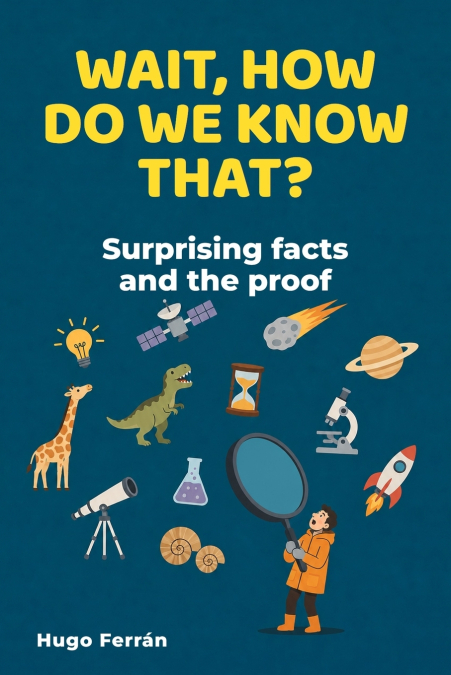
Hugo Ferrán
Everyone has heard the famous numbers: the size of the Earth, the speed of light, the age of the planet. Almost nobody has heard how anyone worked them out.Wait, How Do We Know That? gathers 120 surprising facts, each one with its proof. Every entry is a short, self-contained capsule built the same way: the fact that sounds made up, the story of who found it out and with what tools, the common mistake about it, the evidence explained step by step in plain language, and the sources, so you can follow the trail yourself.A few of the stories inside: · How the shadow of a stick in two cities was enough to estimate the size of the planet more than two thousand years ago; · How an eclipse of one of Jupiter’s moons that ran about ten minutes late showed that light takes time to travel; · Why blood is not the same for everyone, and who first noticed; · How a team went to the Canadian Arctic because of the age of the rocks, not knowing what they would find, and came back with a fish that had a neck and fins with wrist-like joints; · Why twenty-three people in a room make a shared birthday more likely than not, and the arithmetic that explains it; · Why a giraffe has the same number of neck bones as you do.The book is organized in eight parts: The Sky and the Earth, The Body and Medicine, Animals and Plants, Numbers and Chance, History and Languages, Inventions and Technology, The Mind and Behavior, and Deep Time. Each part opens with a short introduction, and all 120 capsules come with their own full-color illustration in the style of a scientific plate.What sets it apart from other books of curiosities: · It goes beyond 'did you know?': it shows the proof, with the data, the instruments and the dates. · It sets the record straight on the common mistake without talking down to anyone. · When the evidence falls short, it says so. · It ends every capsule with sources, so you can check them yourself.This is a book to dip into, one capsule at a time, on the couch, on a train or before bed. It also makes a great gift for the person who always asks, 'Wait, who says so?' No scientific training is needed: every explanation is written for any curious adult who wants to understand how we know what we know.Pick it up, and you will never again hear an amazing fact without asking the question that changes everything: how do we know?