Sascha Ferber
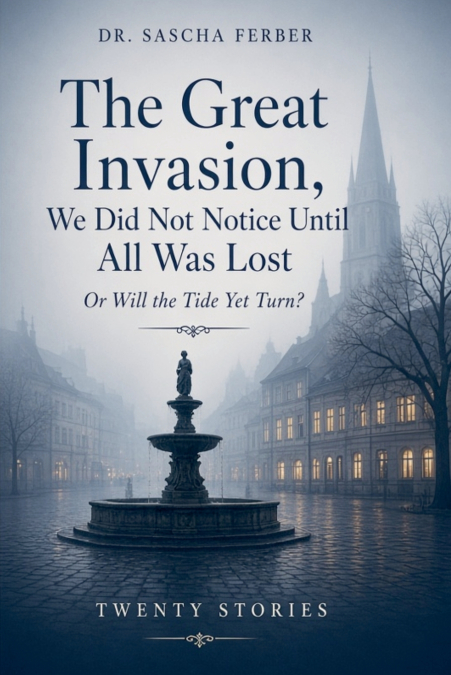
In an unnamed Central European city, fog settles one October morning and does not lift. For Konrad Weidlich, a retired surveyor, it becomes the first unmistakable sign of a deeper shift. Familiar faces at the bus stop disappear. The language in the stairwell changes. The baker on the corner closes without a word. Step by step he measures what can no longer be measured: the loss of orientation, of shared rules, of the taken-for-granted world that a place once possessed.These twenty stories follow people who notice what others still overlook or no longer dare to say. An elderly woman continues to polish a doorbell panel whose names she can no longer read. A doctor hears certain subjects vanish from conversations with his patients. A former bookkeeper begins an inventory of her city: which shops remain, which streets she can still walk alone after dark, which words she may still speak. In a bookbinder’s workshop seven people meet and ask, quietly, whether what is happening is already an occupation-or something that has not yet been given a name.Dr. Sascha Ferber tells these stories with the precision of a chronicler and the restraint of an observer. There are no loud accusations, no simple enemies. Instead, dense images of gradual loss appear: the playground that follows different rules after dusk, the festival that grows smaller each year until it is cancelled, the church service that is ever more sparsely attended. Throughout, the question that forms the book’s subtitle remains open: Or will the tide yet turn?The turning that is hinted at is neither large nor triumphant. It consists of small, stubborn gestures: people who go, on certain mornings, to places where the fog is thinner and speak to one another for the first time. A bowl of cake left on the stairs. A plan for sweeping the pavement rewritten. A story hour for children who still want to hear the old tales. A single sentence written on a sheet of paper: 'We begin with what we still have.'The volume is explicitly fiction. Places, persons, and events are invented. Yet the atmosphere of a profound demographic and cultural change is palpable, without the stories becoming a roman à clef or a pamphlet. They stay with the individual: with what is seen, what is lost, and what is still held onto. The responsibility of those who were already there-the looking away, the falling birth rates, the sale of houses-is not omitted. At the same time, the consequences of mass immigration are neither relativized nor softened.For readers who sense that something has come upon them which they long preferred not to notice, the book offers no comfort, but a clear language and the quiet possibility that precise seeing and not simply walking on may be the beginning of something. It rarely ends with certainty. More often it ends with an open gaze, a sentence not yet finished, or the decision to go back the next morning.'The Great Invasion We Did Not Notice Until All Was Lost' is neither a call to arms nor a lament. It is a collection of observations and small decisions. It asks what remains when the familiar disappears, and whether it is still possible to stand, in certain places, until the fog-not everywhere, not entirely-begins to brighten at the edges. The answer stays open. But the question is asked.