Inicio > Medicina > Medicina clínica e interna > Neurología y neurofisiología clínicas > Restless Legs Syndrome - RLS and Deep Brain Stimulation
Restless Legs Syndrome - RLS and Deep  Brain Stimulation

Restless Legs Syndrome - RLS and Deep Brain Stimulation

Khosro Hekmat

45,91 €
IVA incluido
Disponible
Editorial:
Khosro Hekmat
Año de edición:
2026
Materia
Neurología y neurofisiología clínicas
ISBN:
9798237921830
45,91 €
IVA incluido
Disponible
Añadir a favoritos

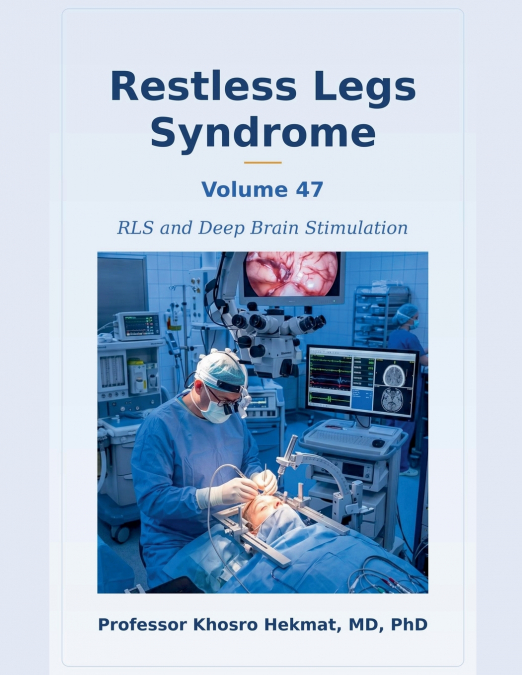
Can a pacemaker in my brain quieten my legs? Two hair-fine electrodes are pushed through the skull into a nucleus of the diencephalon a few millimetres across and connected to a pulse generator below the collarbone. In Parkinson’s disease and in tremor this is an established and effective procedure. Anyone who cannot keep still at night rightly asks whether it might work for them too. This volume says what sixty-nine described people really yield - and why not one of them was operated on because of the restless legs. It shows why a few millimetres decide the direction of the effect, and how the same stimulation can also cause the complaints. It also puts the question that concerns the whole field: why, in all these studies, did nobody measure the legs but only ask about them? And what does it actually mean to be regarded as impossible to control with medication? WHAT IS IN THE BOOK- What a brain pacemaker is and how it is implanted- What risks an operation on the brain carries- Why the thalamus appears in almost every study of this condition- Whether the people operated on have the same illness- What happened in twenty-two people with Parkinson’s and thirteen with tremor- Whether a brain pacemaker can also trigger restless legs- Whether the improvement comes only from reducing tablets afterwards- What applies when brain surgery is planned anyway and restless legs come with it WHO THIS BOOK IS FORFor people with Parkinson’s disease or tremor facing deep brain stimulation who also have restless legs, for patients to whom the procedure has been suggested, and for everyone who wants to know where the limit of established knowledge runs. ABOUT THE SERIESVolume 47 of 52 in the book series on restless legs syndrome, part 'Device-Based Treatments and Research'. Every volume can be read on its own. The statements in this volume rest on 203 professional sources, each one listed individually in the reference section.
Artículos relacionados

  • Handbook of Research on Innovations in the Diagnosis and Treatment of Dementia
    Ionnis Tarnanas / Leontios Hadjileontiadis / Panagiotis D Bamidis
    Technology is playing an increasing role in the lives of the elderly. One of the most prevalent developments for the aging population is the use of technological innovations for intervention and treatment of individuals with mental impairments. The Handbook of Research on Innovations in the Diagnosis and Treatment of Dementia offers empirical research and theoretical analyses o...
  • Biomedical Engineering and Cognitive Neuroscience for Healthcare
    Jinglong Wu
    New developments in medical technology have paved the way for the ongoing studies of cognitive neuroscience and biomedical engineering for healthcare. Their different but interconnected aspects of science and technology seek to provide new solutions for difficult healthcare problems and impact the future of the quality of life. Biomedical Engineering and Cognitive Neuroscience ...
  • Handbook of Functional MRI Data Analysis
    Jeanette A. Mumford / Russell A. Poldrack / Thomas E. Nichols
    ...
    Disponible

    66,35 €

  • How Do You Feel?
    A. D. Craig
    A book that fundamentally changes how neuroscientists and psychologists categorize sensations and understand the origins and significance of human feelingsHow Do You Feel? brings together startling evidence from neuroscience, psychology, and psychiatry to present revolutionary new insights into how our brains enable us to experience the range of sensations and mental states kno...
    Disponible

    43,72 €

  • Deep Learning Approaches for Early Diagnosis of Neurodegenerative Diseases
    Within the context of global health challenges posed by intractable neurodegenerative diseases like Alzheimer’s and Parkinson’s, the significance of early diagnosis is critical for effective intervention, and scientists continue to discover new methods of detection. However, actual diagnosis goes beyond detection to include a significant analysis of combined data for many cases...
  • Ignite Global Change
    Alessandro Crimi
    Your essential guide to global entrepreneurship and activism. From Accra and Mumbai to Milan and New York, a vibrant new generation of activist entrepreneurs turn visionary ideas into impactful realities. Ignite Global Change offers a roadmap for crafting wealth from minimal resources, from ideation to implementation. Its practical, real-world approach provides strategies that ...
    Disponible

    23,34 €

Otros libros del autor

  • Restless-Legs-Syndrom - RLS und Schlafapnoe
    Khosro Hekmat
    Zwei Störungen, eine Nacht.In einer Untersuchung an 490 Erwachsenen mit Schlafapnoe hatte fast jeder Fünfte zugleich ein Restless-Legs-Syndrom, und nur bei 12 dieser 91 war es zuvor erkannt worden. Beide zerstückeln den Schlaf, beide machen müde. Wer für seine Erschöpfung eine Erklärung gefunden hat, übersieht leicht die zweite - und daran kann die Behandlung scheitern.Dieser B...
  • Restless-Legs-Syndrom - RLS und gesunder Schlaf
    Khosro Hekmat
    Endlich wieder ruhig schlafen?Neun von zehn Menschen mit einem Restless-Legs-Syndrom schlafen schlecht ein oder schlecht durch. Der gestörte Schlaf ist die eigentliche Hauptlast der Erkrankung, und er ist der Grund, aus dem die meisten Betroffenen überhaupt Hilfe suchen. Dieser Band nimmt ihn ernst: als Behandlungsgrund, nicht als Schicksal.Schritt für Schritt wird erklärt, was...
  • Restless-Legs-Syndrom - RLS und Narkolepsie
    Khosro Hekmat
    Zu wach in der Nacht, zu müde am Tag.Die eine Erkrankung lässt Menschen einschlafen, wo sie wach sein wollen. Die andere hält sie wach, wo sie schlafen wollen. Und doch sind unruhige Beine bei der Narkolepsie vom Typ 1 häufig. In der einzigen Untersuchung, die Betroffene persönlich untersucht hat, erfüllten 20 von 66 Menschen ohne Medikamente die Kriterien, in einer Gruppe, die...
  • Restless-Legs-Syndrom - RLS, PLMS und PLMD
    Khosro Hekmat
    Die Beine, die nachts weitermachen.Auf dem Schlaflaborbefund steht eine Zahl: der PLM-Index. Bei jedem dritten Erwachsenen mittleren Alters liegt sie über der üblichen Schwelle, bei älteren Männern bei sechs von zehn. Und kaum jemand erklärt, was sie bedeutet.Dieser Band trennt drei Dinge, die ständig verwechselt werden: das Restless-Legs-Syndrom als Erkrankung, die periodische...
  • Restless-Legs-Syndrom - RLS und Fragebogen
    Khosro Hekmat
    Was sagt mein Wert - und was sagt er nicht?Für das Restless-Legs-Syndrom gibt es keinen Bluttest und kein Bild. Es gibt Fragen, und aus ihnen sind Instrumente entwickelt worden, die die Diagnose unterstützen, den Schweregrad messen und Rezepte und Häufigkeitsangaben prägen. Wer sie nicht versteht, wird von ihnen in die Irre geführt.Dieser Band sagt, welches Instrument wofür da ...
  • Restless-Legs-Syndrom - Biomarker und Entzündung
    Khosro Hekmat
    Kein Wert beweist die unruhigen Beine - aber zwei entscheiden, was hilft.Es gibt keinen Bluttest für das Restless-Legs-Syndrom. Trotzdem werden bei kaum einer anderen Erkrankung so viele Werte bestimmt und so oft falsch gelesen. Ein Ferritin im Normbereich ist für die Beine oft zu niedrig, und eine Entzündung kann es anheben, sodass der Eisenspeicher voller wirkt, als er ist.Di...