Shane Larson
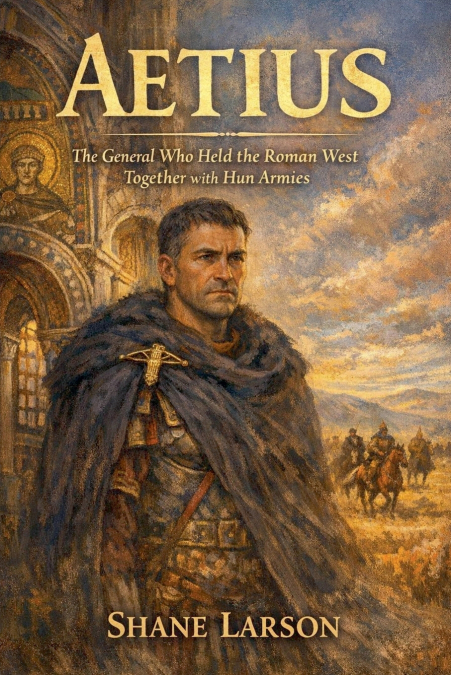
The man who stopped Attila spent a quarter of a century using Hun armies against Romans. Then the emperor he had put on the throne killed him with his own sword.Flavius Aetius was a hostage among the Goths as a boy and among the Huns as a young man, and he came home with something no other Roman general of his generation had: friends on the steppe. In 425 he marched into Italy at the head of a Hun army to prop up a usurper and arrived three days after the usurper had been beheaded. The regent he had come to depose hired him. In 432 he lost a Roman civil war outside Rimini, fled to the Hun king Rua, and came back the next year with Hun backing to take the supreme command in the West. In 436 and 437 Hun forces destroyed the Burgundian kingdom on the Rhine so completely that the slaughter became the last act of the Nibelungenlied. He sent his own son to live at Attila’s court. Then, in 451, the Huns came west as enemies, and he met them on the Catalaunian Plains with Visigoths, Alans and Franks, because the force he had built his career on was now on the other side of the field.Procopius wrote that a man would not be wrong to call Aetius 'the last of the Romans.' He gave the same title, in the same sentence, to Boniface, the rival Aetius fought at Rimini. This book takes that sentence seriously. It is the story of the last two men who could have held the Western empire together, and of what happened when they spent their strength on each other while the Vandals took Africa.No ancient life of Aetius survives. The book is built from the chronicles, the fragments and the one broken panegyric that do, and every scene names its witness: who wrote it, when, and whose side they were on. Where the record is silent, the book says so. Where historians disagree, it sets out the disagreement instead of settling it by assertion.What you’ll learn:How hostage diplomacy worked, and what a Roman boy learned in a Gothic camp and then a Hun oneWhy Galla Placidia hired the general who had marched against her son, and how he removed two rivals in a decadeWhat the Hun card bought in Gaul, and why it stopped working the moment the Huns had a single king who no longer needed RomeHow the destruction of the Burgundians became the NibelungenliedWhy Carthage fell on 19 October 439 while the West’s best army was in Gaul, and what its loss did to the army’s payHow the coalition of 451 was assembled from former enemies, and why the army sizes in the sources cannot be taken at face valueWhat happened in the palace in September 454, and why the emperor was dead six months later at the hands of Aetius’s former guardsmenThis book is for you if:You know Aetius as the Roman name in Attila’s story and want the thirty years before itYou read fall-of-Rome history and want the generals who actually ran the Western empire, not only the emperors who reigned over itYou care how thin evidence is handled, and want a book that labels its reconstructions and invents nothingA courtier told Valentinian III he had cut off his right hand with his left. Within a year the emperor was dead and Rome was sacked. This is how that hand was made, and why it was cut off.